Showing posts with label fibromyalgia. Show all posts

Wednesday, December 28, 2011

Patients Say Hydrotherapy Is More Effective Than Lyrica

The above chart is the combined results of a 3 year study by Cure TogetherCure Together is a worldwide group of patients who have pooled their resources in order to find effective treatments. In this study the patients are all suffering from Fibromyalgia.

The chart rates medicines by their effectiveness and also their popularity with doctors.  If a treatment is listed in the upper right segment of the chart, it would be both popular (widely recommended), and considered effective. As you can see, the top treatments are pretty simple - hot bath, rest, and plenty of sleep.

One small problem - Fibromyalgia sufferers often have difficulty getting much sleep or rest due to their constant pain. In face, sleep disorders are a common symptom of Fibromyalgia. Very little is understood about the disease, which is why a study done by PATIENTS is critical.

One of the most interesting factors is that Hydrotherapy (using water to treat & heal the body) is rated by patients as a very effective method of pain relief. Medications such as Lyrica, Cymbalta, and even Prozac are widely known and presecribed by doctors as treatments - yet are not considered to be effective in terms of pain relief.

What's really amazing - you can get your own hot tub for about what it would cost you to buy less than a year's worth of any of the above medications.


Monday, December 19, 2011

Hot Tub Safety Tips

hot tubs spas

Portable hot tubs and Jacuzzis are becoming a major fashion accessory, they are relaxing, affordable and best of all can be taken almost anywhere with you. People usually purchase a hot tub to relax and unwind. Hydrotherapy is an excellent natural pain & stress reliever. 

Of course you want to operate your tub safely. 

A lot of people like to use different temperatures of the hot tub, but to be safe; you should keep at a healthy heat and not overdo it. If you raise the temperature to a very high level, your skin can end up being damaged and potentially burnt. The general temperature that should be reserved is around 95-100 degrees.

Besides from burning your skin, having high temperatures can also cause a variety of other problems, particularly if you are suffering from aspects of high blood pressure. It has been medically stated, that constant high temperatures of heat and water can cause a dilation effect of the blood vessels.
With portable hot tubs you should also be careful not to trap your hands or fingers, while you are in the process of moving it around.

Hot tubs are a great way to relax, it has been said that spending 30 minutes a day in the hot tub will make you feel healthier and live longer. But do not take hot tubs for granted, just as with any other relaxation methods, you will have to take great care so you do not end up causing yourself injuries.

Thursday, December 15, 2011

Aero Spa Review


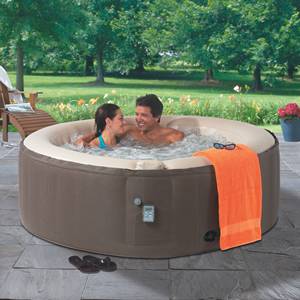
The Aero Spa is one of the easiest and most affordable hot tubs you can own. (Retails for $899.00, but you can find bargains.) The new Aero Spa Hot Tub can be placed almost anywhere in your backyard, patio, deck, carport or even take it along on the family camping trip. There is no installation involved.  Simply remove the spa from it’s box, plug it in and watch the aero spa inflate in minutes. (It ships at about 50 lbs.)  Fill the spa with a simple garden hose, turn on the filter and heater and you will be ready to enjoy your very own hot tub – it is that easy. This portable hot tub is roomy enough for up to 4 adults (holds 211 gallons of water) and will heat up to 104 degrees.  There are 130 massaging jets, so you’ll get plenty of hydrotherapy.  And it plugs into a 110 volt outlet, so you won’t need special wiring.

Zippered Spa Cover

Spa Controls

The Aero Spa has a 3 month warranty which is only valid in the United States. The vinyl construction is surprisingly durable, and comes with a zippered thermal cover to retain heat.
The main drawback to the Aero Spa is that it can lose heat while using it, but that is a problem with any tub. It has a simple look also, so if you are into a lot of fancy bells and whistles, this isn’t the tub for you.
Here are a couple of comments we found.

“I am very pleased so far with the Aerospa! It was exactly what I was looking for! It is only my husband and I so the size is just right…I wouldn’t expect to have 4 people in it at a time, 2 is the limit unless you want to be touching other people, and we are not big people…I was disappointed that there was not a starter chemical set but I went to the nearest pool supply store with my product owners manual and they helped me choose the products I needed.”  Lisa Stewart, Columbus OH

“This is a great little tub. I got it to help with arthritis, and it does just that. I was really surprised with the bubbles! There is no problem with the heat, and its easy to take care of.” 
Harold Jenkins, Dearborn, MI

Hydrotherapy Through The Ages

The term “hydrotherapy”  refers to the use of water to treat pain or afflictions.  It has been a proven and effective method of treatment for all types of ailments.  Hydrotherapy has been known to improve blood circulation, loosen muscles and joints, reduce stress, and even improve quality of sleep.   Unlike pills and potions which are peddled non-stop through the media, and have all types of adverse side effects…..the only side effect with hydrotherapy is FUN.  It’s totally natural!

Hydrotherapy has a long and vibrant history, dating back well over 2000 years. The first known documented use of hydrotherapy was by the Greek physician, Hippocrates in about the 5th Century B.C.  The ancient Roman civilization integrated hydrotherapy into their social life. They built public baths near natural springs, for health and wellness, and these became gathering spots for  local elders to discuss the events of the day while they bathed. 

The Bible also refers to the use of hydrotherapy.  John 5: 1-16 tells how people would use the healing pool of Bethesda.   When the waters stirred, the first person into the pool was healed of any disease they had.   One man, who was crippled, had tried unsuccessfully to get into the pool for 38 years!  The story tells us that he was healed by Jesus, who told him to Rise and walk.  Of course,  the sacrament of Baptism (Greek for “washing”), uses water even today as a symbol of cleansing and renewal.  

Sebastian Kniepp, a Dominican priest in Germany, is the Father of Hydrotherapy as we know it today. Father Kniepp, born in 1821, was stricken with pulmonary tuberculosis while he was studying for the priesthood.   This disease was considered fatal at that time.  He became intrigued while watching a wounded deer bathe in a stream.   He would take short full immersion dips in the icy waters of the Danube River.  This treatment enabled him to stimulate his immune system.   His tuberculosis went completely into remission, and he was able to resume his studies.   He dedicated the rest of his life to learn more about the healing powers of water, and wrote a book titled My Water Cure,  in 1886, which was translated into several languages and distributed throughout the world.

Baseball was still new in America in 1886.   The Chicago White Stockings pioneered an idea which has since become tradition.  The team traveled south in March to Hot Springs, Arkansas to prepare for the upcoming season.  The team’s president, A.G. Spalding, wanted them to rid their bodies of alcohol and get in shape.
He thought that the Southern climate would be better for this purpose. Also the players could bathe in the hot (147 degrees Fahrenheit) natural spring water,  loosening their muscles after workouts.  Hot Springs became a regular visit for spring training for several baseball teams, including the New York Yankees of the 1920s, led by slugger Babe Ruth.

In 1948, a family of Italian immigrants, the Jacuzzi brothers, invented the first hydrotherapy pump in Berkeley, California.  One of their children, Kenneth, suffered from rheumatoid arthritis, and the pump was developed to treat his pain at home.  The pump would be used to agitate the water.   They learned that circulating the water was quite effective in soothing arthritis pain.  Another family member, Roy Jacuzzi,  is credited with inventing the first whirlpool tub in 1968.  His tub featured jets which were built directly into the walls of the tub. 

Hot tubs at that time were limited to the very wealthy.   How would it be possible to make hot tubs which anyone could afford?  That was a question which plagued Tom Thornbury in 1985.  He decided that hot tubs could be made which were both affordable and easy to use.  One of his innovations was to use layered foam in the construction of the tub.  The  foam was lightweight, durable and quite comfortable for the user. It was also functional as an excellent insulating material.   Another innovation was being able to use a heat exchange system to heat the water using only excess heat from the pump.  This saved considerably on power usage and also prolonged the life of the motor.  Since the motor could be plugged into any outlet,  the tub could be used anywhere.  Tom Thornbury’s company, Softub, incorporated in 1986, and has customers worldwide.  In 2011, the company celebrated its Silver Anniversary.

The history of hydrotherapy is still being written.  It has been proven to treat a variety of ailments for thousands of years.  Hydrotherapy reduces stress, improves blood circulation, loosens stiff joints and muscle pain,  improves sleep, and helps you to enjoy life.    Hydrotherapy helps you feel better naturally.  What ailments do you suffer from?  How will you continue the story of hydrotherapy in your life?